


AI model tracks ‘unusual’ satellite activity for collision prevention
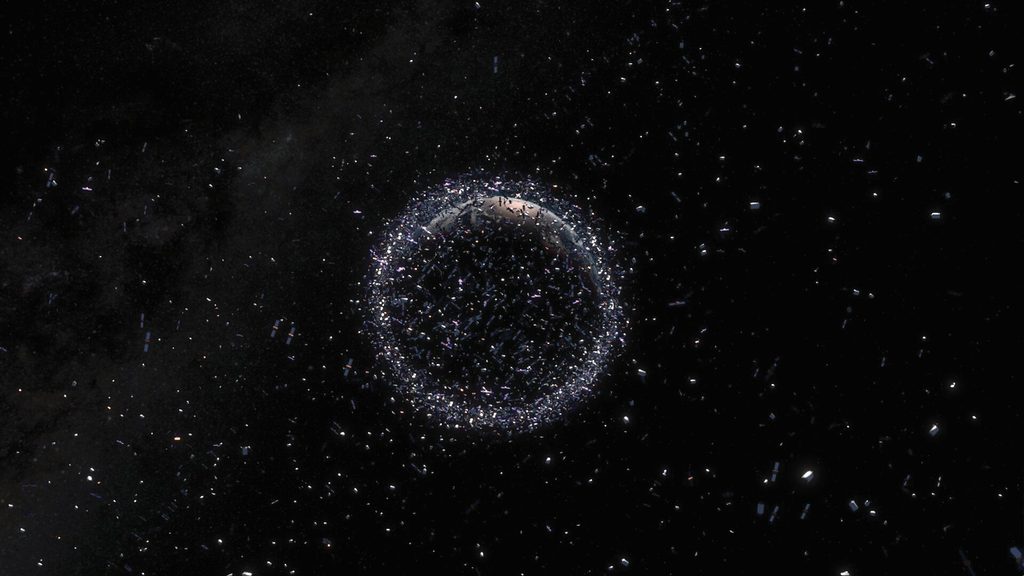
(Image: ESA/ID&Sense/ONiRiXEL)
A new AI model uses light reflections to predict anomalies in satellite motion, writes Chris Young. Developed by researchers from the Alan Turing Institute’s Defence AI Research Centre (DARe), the new model could greatly reduce the risk of satellite collisions.
There are over 16,500 active satellites in Earth’s orbit, and more than 1.2 million pieces of space debris larger than 1 cm in diameter. These soar through space at the speed of a bullet, flying around our planet at up to 18,000 mph. With many thousands more satellites planned for launch, the collision risk is rising at a frightening pace.
The DARe team used a Foundational Model, designated AI4S3, marking the first time such a model has been used for Space Object Behavioral Analysis.
Foundational Models use large neural networks pretrained on mostly unlabelled datasets that are then fine-tuned to take on a variety of general tasks.
The DARe team trained its model on a database of ~227,000 light curves from the MMT Observatory operated by the University of Arizona and the Smithsonian Institution, allowing it to understand satellite behaviour. The model was then refined using simulation data from the Aerospace Centre of Excellence at the University of Strathclyde and technology and engineering group GMV. The resulting tool is the first capable of predicting anomalies and satellite motion by observing the way light reflects off diverse orbital objects.
In tests, AI4S3 was able to identify unusual light curves in real-time data 88% of the time, and differentiate satellite behaviours, such as spinning and tumbling, critical for in-orbit servicing operations.
By including radar data, hyperspectral data and satellite orbit data, the DARe team believes it could improve the model’s capacity for preventing collisions that could cascade into the destructive Kessler syndrome.
UPCOMING EVENTS