Supertorquer set to be ‘most powerful magnet actuator’ ever flown
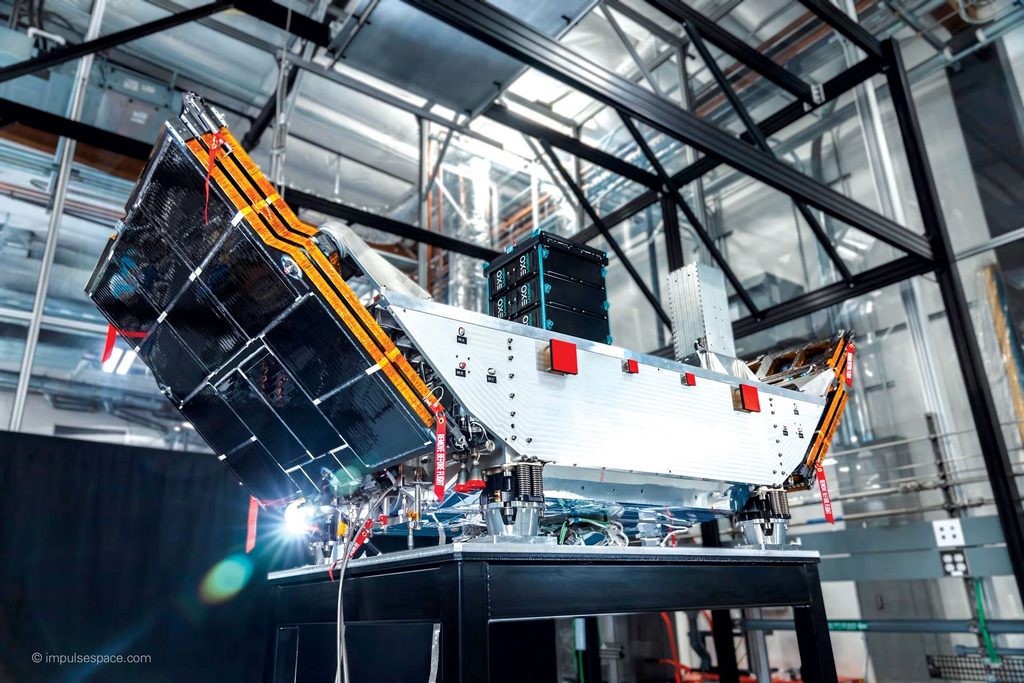
(Image: Impulse Space)
Zenno Astronautics has integrated its flagship Supertorquer aboard Portal Space Systems’ Starburst-1 spacecraft, writes Chris Young. According to the Auckland-based company, Supertorquer will be the most powerful magnetic actuator ever flown.
Supertorquer leverages the same core principle as conventional magnetorquers. It generates a powerful magnetic dipole that produces torque through its interaction with Earth’s magnetic field, allowing fuel-free attitude control.
The key differentiator is Zenno’s use of superconducting electromagnets, chosen for their “unprecedentedly high electrical currents with near-zero energy losses.” While magnetorquers are ineffective beyond LEO owing to degradation of Earth’s magnetic field in higher orbits, Supertorquer’s power allows it to function in MEO and GEO.Although iterations of Supertorquer have already flown to space, the model that will fly on Starburst-1 is significantly stronger. The team at Zenno has dubbed the upcoming mission the ‘Almighty Magnet’.
As a point of reference, Zenno Astronautics’ first in-space technology demonstration, which flew aboard a D-Orbit ION Satellite Carrier mission in 2023, generated a magnetic dipole of roughly 10 A·m². In 2025, Zenno launched a new iteration – the Z01 Supertorquer – aboard Impulse Space’s Mira spacecraft. Zenno Astronautics’ co-founder and CEO Max Arshavsky described that model as a “full commercial array generating 10 times the field strength across three axes” when compared with the 2023 unit.
That would place it in the rough ballpark of ~100 A·m². The Almighty Magnet mission aims to demonstrate a significantly more powerful magnetic dipole of up to 3500 A·m². Using Zenno’s magnetic system, a mission’s propellant budget won’t have to account for attitude control, allowing more fuel to be reserved for manoeuvring or station-keeping.
Interestingly, that powerful magnetic field might also double up as radiation shielding. Supertorquer has shown promising results in the laboratory, and a charged-particle counter will measure the effect in space during the Starburst-1 mission.
“Fuel-free control authority at this power level has never been demonstrated in orbit. We are about to prove it,” said Arshavsky, adding: “Superconductivity is where the next decade of spacecraft manoeuvrability gets decided, [and] Starburst-1 is where we show the industry what that looks like in practice.”
UPCOMING EVENTS