




Exceptional precision’ optics used to spy on plant health from outer space
(Image: Fraunhofer IOF)
OpticsESA mission FLEX launched a ‘Fluorescence Imaging Spectrometer’ (FLORIS) to space on September 15, 2026, aboard a Vega-C rocket from Europe’s Spaceport in French Guiana, writes Chris Young.
Researchers at the Fraunhofer Institute for Applied Optics and Precision Engineering IOF in Jena, Germany, built the high-precision optical components to read plant health from space with extreme precision.
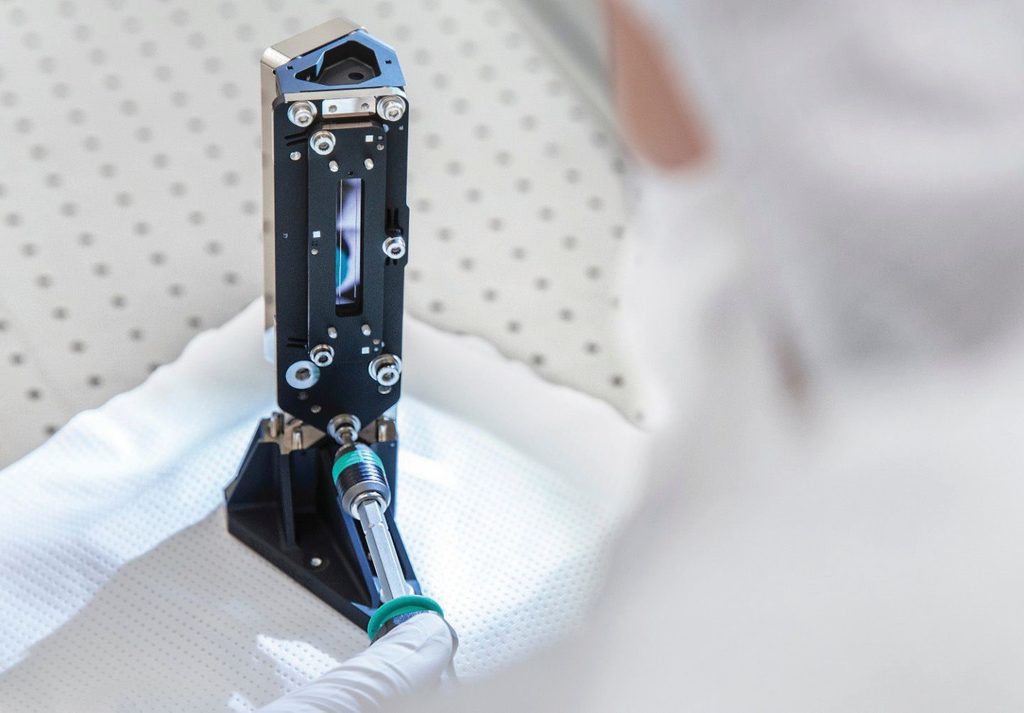
For the spectrometer, the researchers developed and manufactured a silicon-based double-slit assembly, as well as two high-precision mirrors. The system monitors plant health via plant fluorescence.
FLORIS’s extremely precise dual-slit assembly allows it to operate with two light channels rather than the conventional single channel. One channel collects high-resolution information on closely matched wavelengths while the other covers a wider range of the light spectrum.
Each of the two slits is a mere 85 µm wide over a length of 44.15 mm. During manufacturing, permissible deviation was only ±1 µm – to put that into perspective, the diameter of a human hair ranges from 17 to 180 µm.
To achieve the required manufacturing precision, the researchers developed a specialised lithographic process chain for silicon wafer structuring. First, the wafers were masked, patterned and wet-etched under strict timing conditions. Then, the slits were coated with a black layer to achieve the desired optical properties.
The sensitive silicon element was placed in the holder with precision of less than 5 µm in order to maintain a high parallelism to the apertures. The flatness of the slits, meanwhile, had to be under 10 µm.
“The fluorescence signals emitted by plants are very weak,” explained Dr Falk Kemper, project manager for FLEX. “To analyse these signals reliably, the optical components must be manufactured and assembled with exceptional precision.”
UPCOMING EVENTS