
New propulsion systems for an ‘in-space mobility architecture’
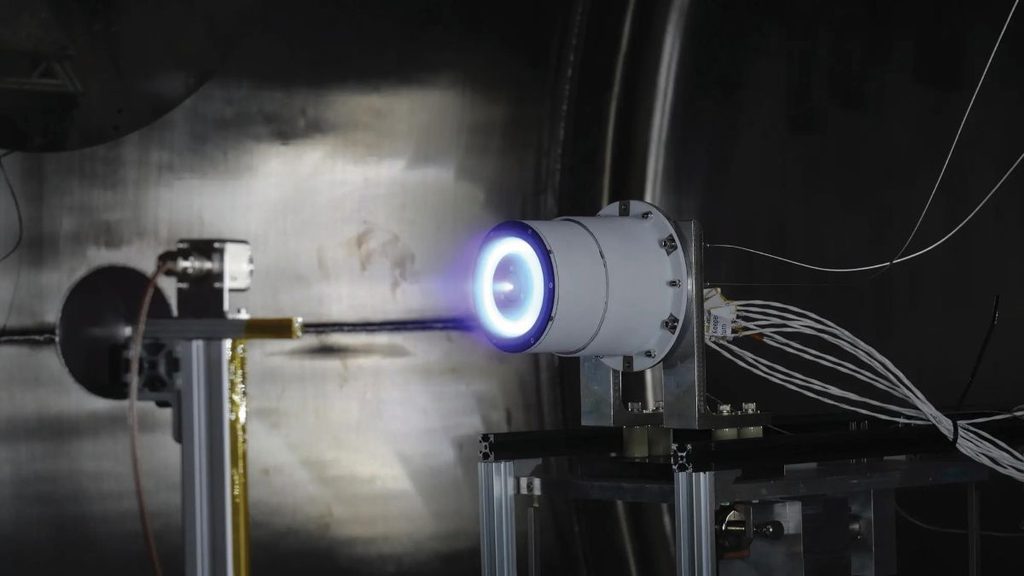
(Image: Impulse Space)
Impulse Space, which aims to power logistics supply chains beyond Earth’s orbit, has announced Electra, its newest propulsion system, writes Chris Young.
With space now increasingly accessible, the next big hurdle for operators is actually staying in space. For many missions, roughly half of a spacecraft’s propellant is reserved for orbital station-keeping, greatly reducing its manoeuvring capability.
According to Impulse, Electra addresses this issue by providing continuous, highly fuel-efficient thrust over extended periods. “If chemical propulsion is a sprinter, electric propulsion is a super-efficient marathon runner,” the company said.
Electra is one of four proprietary propulsion systems the company has announced to date – the others being Saiph, Deneb and Rigel. It is Impulse’s first electric propulsion system and will act as a complement to its chemical propulsion counterparts.
Impulse is currently qualifying Electra for integration with Mira, its flight-proven, highly manoeuvrable spacecraft designed to carry payloads of up to 300 kg, anywhere from LEO to deep space. It will likely reveal more in the way of specs ahead of Electra’s first in-space demonstration, planned to take place on the GEO Express 1 mission slated for early 2027.
Rigel, announced in April 2026, is a 200 lbf class engine that uses non-toxic, storable propellants (nitrous oxide and ethane) to enable fuelling in a matter of hours rather than days. It has a low part count that Impulse credits for making it “an order of magnitude lower-cost than conventional systems.”
Rigel’s flexibility reflects Impulse’s mission to develop a “complete in-space mobility architecture.” The company states that the chemical propulsion system is ideal for landers, in-space manoeuvring, rendezvous and proximity operations, interception and other multiphase missions. Key characteristics include unlimited restartability, deep throttleability for precision manoeuvring and long-duration burn capability for high delta-V manoeuvers.
Impulse Space CEO and CTO Tom Mueller was the first employee Elon Musk hired for SpaceX. His work as lead designer for SpaceX’s Merlin and Draco engines still underpins the workhorse Falcon 9, which dramatically lowered the cost of admission to space over the last 15 years.
UPCOMING EVENTS