


Open Cosmos
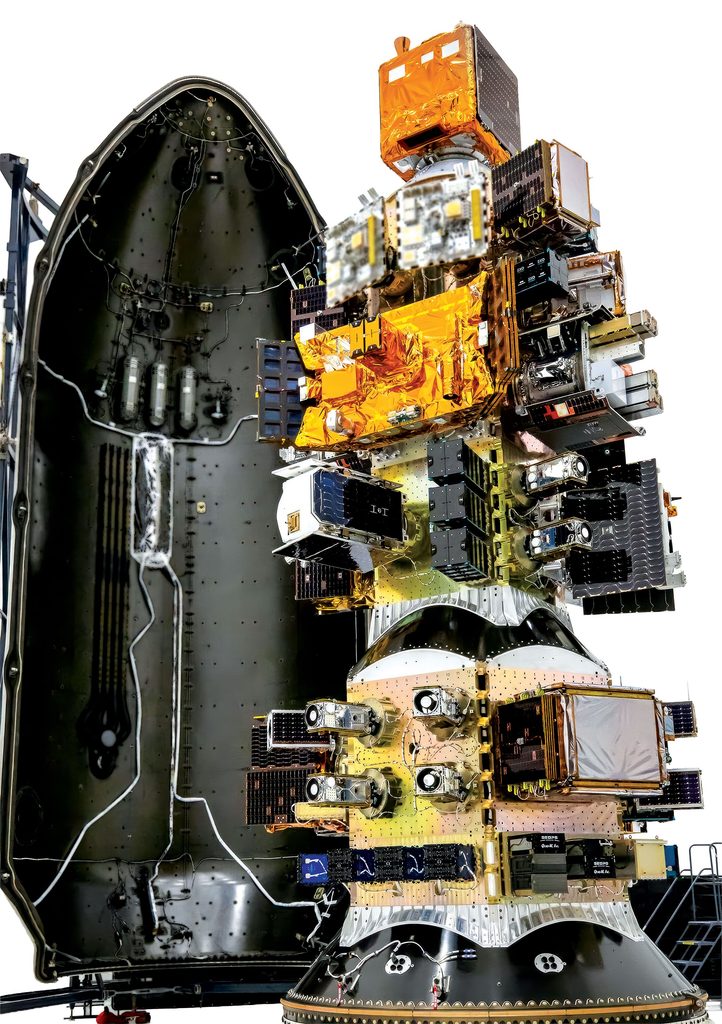
(Image: NASA)
Taking a world view
Open Cosmos designs, builds and operates satellites that collect actionable data to improve life on Earth. Nick Flaherty finds out how
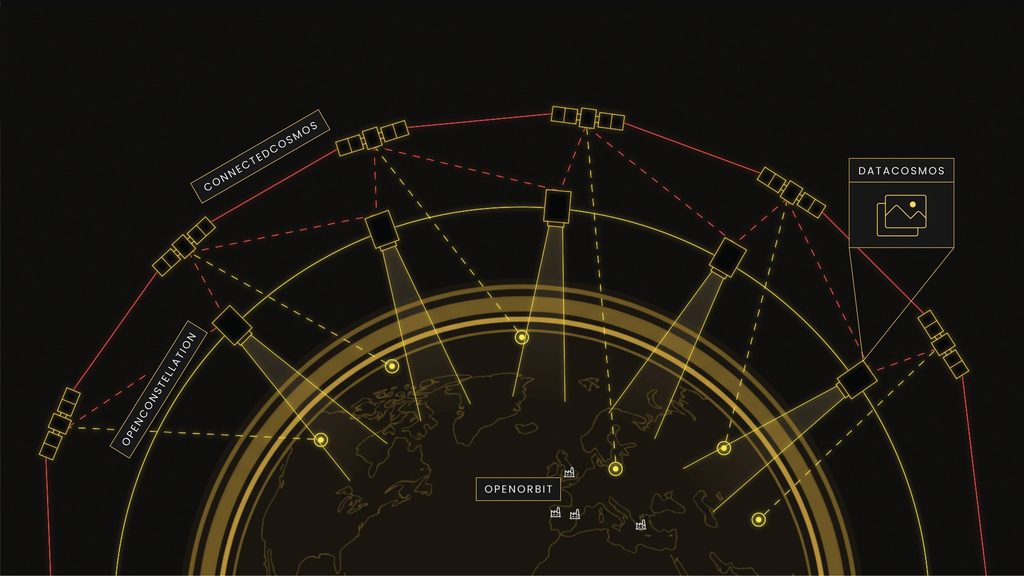
Open Cosmos provides space missions as a service to provide data and intelligence, as well as aiming to deliver connectivity services. Building affordable LEO satellites and offering shared space infrastructure, the company aims to remove traditional financial and technical barriers to orbit. There are four elements underpinning this approach.
First, through OpenOrbit, Open Cosmos can design, develop and operate the satellites depending on customer requirements using COTS components to keep costs, risks and lead times down. The company manufactures in the UK, Portugal, Spain and Greece and, as of writing, has built satellites for 13 missions (see below) with another four planned.
Second, the next-generation shared satellite network called OpenConstellation 1.0 enables countries, businesses and researchers to share orbital infrastructure and Earth observation (EO) data affordably. Two satellites for this network have already been launched out of a full constellation of 15 satellites that is expected to be completed by the end of 2027.
Third, the DataCosmos platform converts raw space data into actionable insights using AI. This technology is essential for tackling urgent global challenges, including monitoring climate change, managing natural disaster responses, tracking deforestation and optimising agricultural resources efficiently across the globe.
Finally, ConnectedCosmos links up satellites in LEO with high-speed laser connections.
“We started with OpenOrbit providing missions as a service for other people, building the satellites and operating them. Having learnt how to deploy satellites in a reliable way, we proposed OpenConstellation as a federated constellation with low latency. Very few companies have the money for a full constellation for earth observation,” said Jordi Barrera Ars, co-founder and chief technology officer. “This means a customer gets data over the region they need and from other satellites.
“DataCosmos is for data and information and that is ramping up as we launch more satellites. Then, there is ConnectedCosmos, which started a couple of years ago, as a point-to-point connectivity layer.”
There are several different flavours for LEO satellites with three platforms all sharing a common architecture using COTS components. “We started with a strategy where we designed a satellite product with common building blocks, compute, comms and power,” said Barrera Ars.
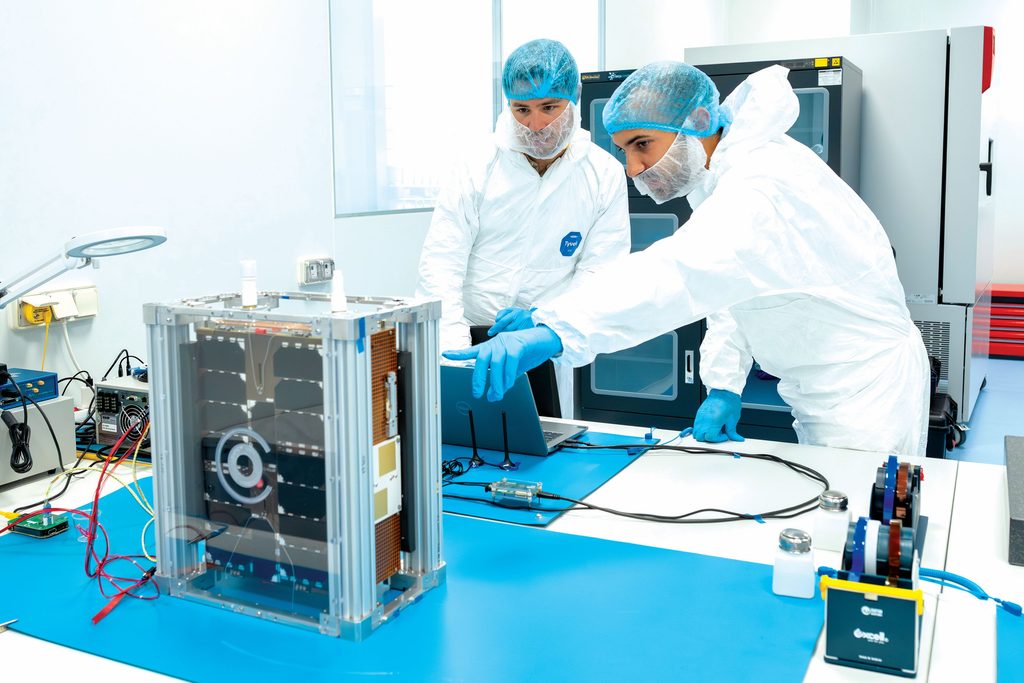
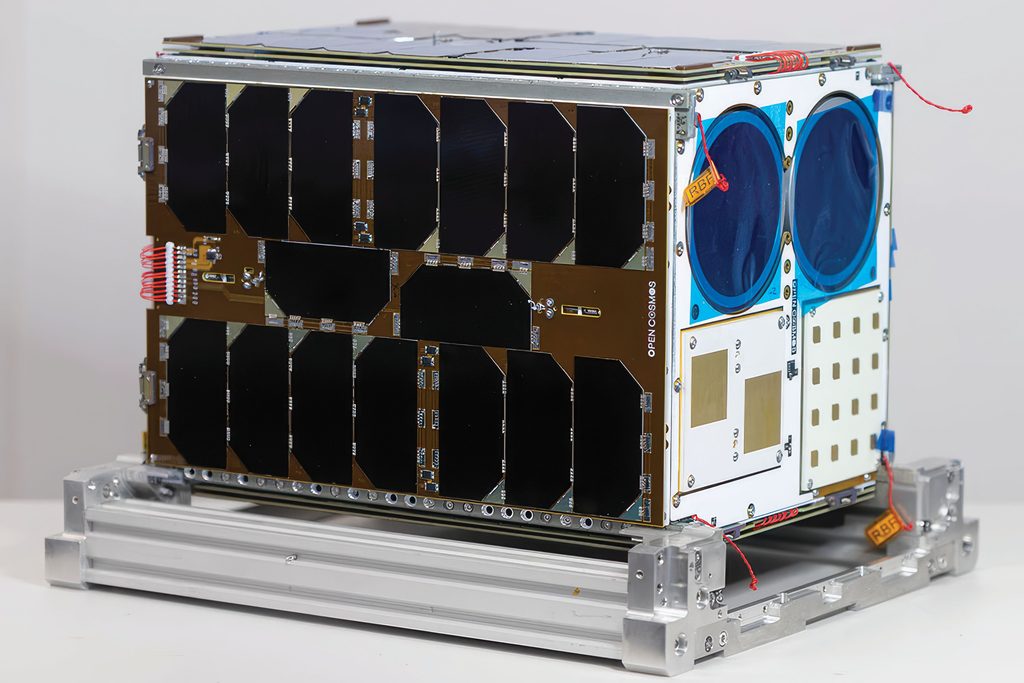
The small satellite weighs around 10 kg and is roughly the size of a microwave oven.
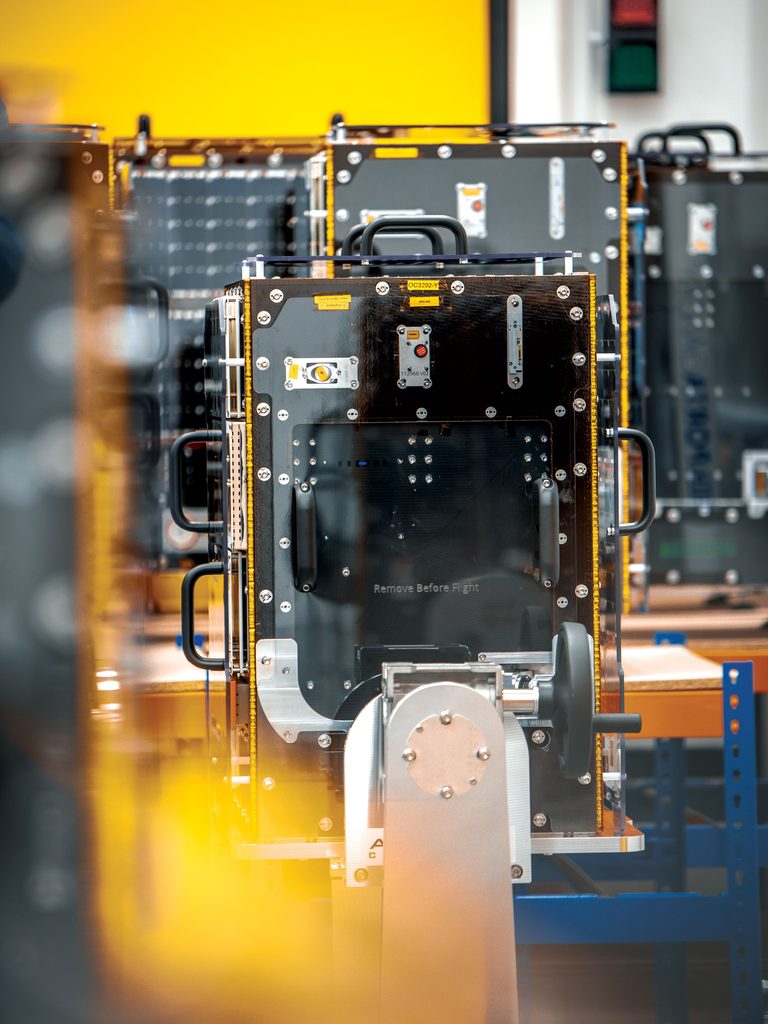
The microsat comes in at 50–600 kg in a family of platforms and there are 100 in production. The satellite size increases with the volume of instruments that may need space or a lot of power. However, the core system is very small and does not really impact on the overall power consumption.
The macrosat has full communications, remote sensing and a larger power requirement in a new family that ranges from 100 to 3000 kg.
“We control the full architecture of the system,” said Barrera Ars. “All the way from 100 W to 10 kW.” The company buys battery cells from a range of suppliers, tests them for operation in space and then builds battery modules that range from 40 to 400 Wh that make up the satellite battery pack.
“We bought cells from many different providers and put them in a rack and cycled them for more than a year to see how they degrade,” he said. “Our batteries need 5000 cycles a year, which is 30,000 cycles over the mission and is more than the lifetime that the manufacturers quote. We also check incoming batches as different factories are producing them even for the same brand.
“We design the boards, produce them, and test and integrate them using commercial technologies with our own qualification environmental testing including some radiation campaigns,” he said.
These are not radiation-hardened chips. “We buy components that are not necessarily designed for space – the key is how we use them. For example, the power system may have derating, so we add protection and error and fault detection – these are the things you have to put in place.”
The packaging does not have to be qualified for space either. “Plastic encapsulation is ok,” Barrera Ars added.
The system architecture is key. While the system is modular, there is no central bus for power and data. “We control each module independently, and it is designed and tested in-house with parallel streams. There are small microcontrollers in each module acting as monitors, that is one of the critical aspects, and the modules are linked by multiple types of data buses, from high-speed SpaceWire and low-voltage differential swing (LVDS) to lower data rate high-reliability buses.”
SpaceWire is a low-cost communication network standard managed by ESA that coordinates bidirectional, full-duplex point-to-point data links. Physically, it uses LVDS over shielded twisted-pair cables with data rates up to 400 Mb/s while ensuring high noise immunity in radiation-heavy space environments.
The protocol uses Data-Strobe (DS) encoding that transmits a data signal alongside a strobe signal that changes state only when the data remains constant. DS encoding simplifies clock recovery and maximises tolerance to jitter, making it suitable for the linkage between modules.
(All images: Open Cosmos, except where stated otherwise)
Data is sent as variable-length packets with a destination address, the main data payload and an end of packet (EOP) control marker indicating normal termination. An error end of packet (EEP) marker replaces EOP if an error occurs mid-transmission.
Error detection relies heavily on character-level parity bits and exchange-level protocols. If a parity or disconnect error occurs, the link automatically resets to prevent data corruption, and the current packet is terminated with the EEP marker to signal downstream nodes to discard the invalid data.
The packet routing relies on low-latency wormhole routing, allowing nodes to transmit data before receiving the entire packet.
The battery packs are then sized to the system requirements. For example, the communications and compute will have a power requirement of around 2 kW and so will need larger batteries, while an electro-optical camera working in daylight will need a smaller pack.
The power comes from triple junction GaAs solar cells that are sourced from several suppliers, with Open Cosmos manufacturing the solar panel. “This has a 32% efficiency as we can keep the satellite smaller with more efficient cells,” Barrera Ars said.
Compute board
There is one AI edge compute board dedicated to the payload data processor. This acts as the central brain to gather data from the instrument, and process and disseminate the data to the communications board. Partners and the in-house data team develop applications as Docker containers that are deployed on the boards. “One of the biggest bottlenecks is if they think about the compute as separate – we have a single system that doesn’t have a bottleneck,” said Barrera Ars.
Imagery and video are processed on a COTS AI module, for example NVIDIA’s Jetson GPU module. “We have learned how to use them reliably over the lifetime of the project, for example by analysing the solder joints. In some cases, we buy the module and sometimes do some modifications for the lifetime by thermal screening. We use a good amount of RAM for storage but the chips are qualified by us and it’s the same with the high-speed non-volatile solid-state disks.”
Memory management is key, and the routing and data transformations are handled by an ingestion FPGA implementing an in-house architecture.
Communications
The near-real-time links are provided by a relay through a geostationary satellite with an L-band RF link at 1–2 GHz.
For core satellite operations, housekeeping data and standard downlinks, Open Cosmos traditionally uses the S-band spectrum for telemetry, tracking, and control (TT&C) with up to 5 Mb/s QPSK or BPSK modulation.
The primary TT&C downlink is 2245.3 MHz and it is often paired with a 2056.6 MHz uplink, while the secondary telemetry downlink is typically at 2261.5 MHz, depending on the specific satellite iteration. Data downlink happens in the high data rate X-band or via inter-satellite links.
Missions
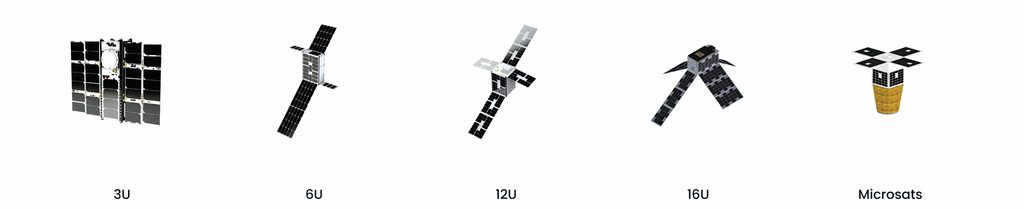
Open Cosmos uses standardised form factors across its CubeSat range – 3U and 6U to 12U and 16U platforms – as well as its microsat and macrosat families for its end-to-end missions. These satellites deploy a range of technologies for EO, environmental intelligence, global connectivity, positioning and orbital edge computing.
The hardware capabilities of Open Cosmos satellites are backed by a standardised mission operations ecosystem. Standardised mechanical, electrical and data interfaces (ranging from 3U up to microsat platforms) allow payload developers to integrate sensors without rebuilding core subsystems (power, ADCS or thermal control).
Flight operations use proprietary cloud-native software that automates routine satellite tasking, orbit propagation, payload scheduling and telemetry monitoring across third-party ground station networks.
Mission data flows into the DataCosmos platform, which applies machine learning algorithms to raw satellite downlinks to provide automated insight generation for end users.
A major focus for Open Cosmos missions is satellite remote sensing for environmental monitoring, agriculture, marine conservation and energy asset management.
ALISIO-1 features high-resolution shortwave infrared (SWIR) imagers capable of piercing atmospheric haze, tracking active wildfires, monitoring soil moisture and evaluating land degradation.
Hyperion GR-1 (the inaugural satellite of Greece’s national optical imaging constellation) is a sub-metric high-resolution satellite, while Menut, PLATERO and Posidònia deploy high-resolution multispectral optical cameras from 5 m down to less than 1.5 m resolution. Posidònia also adds SWIR multispectral as well as visible and near-infrared (VNIR) hyperspectral and the high-resolution VNIR multispectral sensors offering a very unique data cube. These sensors provide near-real-time environmental telemetry across coastal and inland regions to monitor climate change impacts, marine habitats and agricultural patterns.
Traditional EO relies on downlinking raw data to ground stations for processing, creating bandwidth bottlenecks and operational latency. Open Cosmos incorporates edge computing hardware directly into its satellite buses.
Onboard AI processors, a feature of the Phisat-2 mission and the now de-orbited MANTIS mission, execute real-time image filtering, automated cloud detection and target detection before data downlink.
HAMMER, PLATERO and MANTIS combine multispectral imaging, Internet-of-Things (IoT) sensor integration and machine learning models. The raw data and analytics are available directly to sectors such as mining, energy infrastructure and disaster management.
To address the data bottlenecks of high-resolution EO instruments, Open Cosmos also incorporates high-speed optical communications into its small satellite platforms.
ALISIO-1 carries a compact optical laser transmitter module. By transmitting data via high-frequency laser beams rather than traditional RF, these satellites achieve significantly higher data transfer throughputs back to optical ground terminals.
Open Cosmos platforms serve as orbital routers and sensor aggregation hubs, connecting remote terrestrial sensors across unserviced geographical regions. Open Cosmos’ now de-orbited LS2 and Enxaneta platforms acted as orbital relays for terrestrial sensor arrays. These systems processed low-power, high-density telemetry from agricultural probes, maritime markers and industrial assets to enable global IoT coverage during their missions.
Beyond sensing and IoT, Open Cosmos deploys mission payloads for technical validation and orbital testing.
The Dover mission was meant as a technology demonstrator and pathfinder for satellite-based Positioning, Navigation, and Timing (PNT) resilience but never made it to orbit because it was on the failed Virgin Orbit launch from Cornwall in 2023.
6GStarLab provides an in-orbit testbed designed to validate 6G telecommunication protocols, orbital routing topologies and space–ground network integration.
Data management
All the satellites in orbit are connected to a common database. “That means the people designing it don’t have to make assumptions about what might happen and they can drive it from actual data. This keeps the system more optimised so that one can adjust the margins due to lower uncertainties,” said Barrera Ars.
The system data and sensing data are kept separate and the sensing data has telemetry data attached to it.
“All that data is really important,” said Barrera Ars. “Every satellite we launch gives us more data – both a data lake and a series of digital twins. We have simulations that are adapted to run on the system, predicting with AI whether there are issues and spotting anomalies that might go unnoticed.”
There is a single codebase for the entire operation. “OpenApp is internal software that runs the whole company. We use it to produce the satellite, operate the satellites in orbit, deliver data to customers and run all the simulations. It allows us to keep the systems smaller and more reliable, with less people required to produce them.”
The first two satellites for OpenConstellation have been launched, with the full constellation of 15 platforms due to be completed during 2027. The main characteristics are a high-resolution electro-optical camera, a shortwave infrared sensor with four bands and a hyperspectral sensor with 150 bands that provides 18 m resolution.
The satellites cover 3 million square kilometres per day with the capacity for 4–5 revisits, delivering near-real-time data, all processed onboard with an NVIDIA AI processor.
“From what we are doing with our current satellites we expect 20–30% of insights processed on board and the rest on the ground, but we need to confirm that with customers and partners,” said Alberto Perez Cassinelli, VP of Data.
“We download the complete data to our ground stations with several gigabytes when passing by, and we have the inter-satellite link for the smaller analytics with megabytes in near real time.”
“We put everything into the catalogue and we serve those probes through the GUI or through the complete API for machine to machine to integrate into dataflows. We have a complete metadata set for every probe that has the timestamp, origin and calibration data.”
All the software is held in the cloud. “We base the platform on top of the usual major providers in the European and US regions, but we are starting to work with European cloud providers for sovereign aspects, typically telecoms providers but also some cloud providers.”
Integrating AI to explore the data lake is the next step. “The API and the data formats are ready for interfacing with AI agents and we are pushing for it,” said Cassinelli. “We have plans and we have tested some of those components already in orbit.”
He points to the Phisat-2 mission launched in 2024 where Open Cosmos developed a 6U CubeSat with AI capabilities for processing image data in orbit. Software from several European companies including Thales Alenia Space used the sensors and AI to monitor oceans for oil spills and forests for wildfires.
“We have plans for scaling that concept,” he said. “AI is not only for interfacing for the platform on the ground but also in orbit.”
ConnectedCosmos
Everything comes together in ConnectedCosmos. The architecture represents a unified approach to space-based intelligence and security with 192 satellites planned. The network functions through a gateway-less mesh to route data securely via 5 Gb/s optical links between satellites using standard protocols.
This is seamlessly connected to the OpenConstellation satellites, and DataCosmos then processes the images and information into actionable intelligence. The OpenOrbit framework supports the entire lifecycle through Open Cosmos’ pan-European manufacturing and mission expertise. Together, these layers provide more than connectivity by adding active resilience, ensuring that critical data is not only captured but also securely delivered and immediately usable for strategic decision-making.
“We are working on the next-generation laser and have tested this from space to ground and ground to space. The lasers will be compatible with standard protocols to connect to other satellite systems at 5 Gb/s but, increasingly, terminals will take 10 to 100 Gb/s.”
6GStarLab
The 6GStarLab mission is Europe’s first open, in-orbit testbed specifically dedicated to researching and validating 6G non-terrestrial networks. For this, Open Cosmos used its 6U platform that measures 420 x 270 x 133 mm and is nearly 1 m in length with deployed solar panels. The 11.1 kg platform was developed in collaboration with the i2CAT Foundation, Transcelestial, Microwave Sensors and Electronics (MWSE) and the NanoSatLab at Universitat Politècnica de Catalunya (UPC) in Spain. The end result is a virtualised, reconfigurable space environment for testing future telecommunication standards.
Funded as part of Spain’s UNICO I+D 6G initiative and backed by the NextGenerationEU and ESA 6G roadmap, the satellite bridges the gap between ground-based research and real-world space execution with software-defined, reconfigurable payloads that allow researchers to remotely upload, reconfigure, and execute radio and optical communications experiments from the ground.
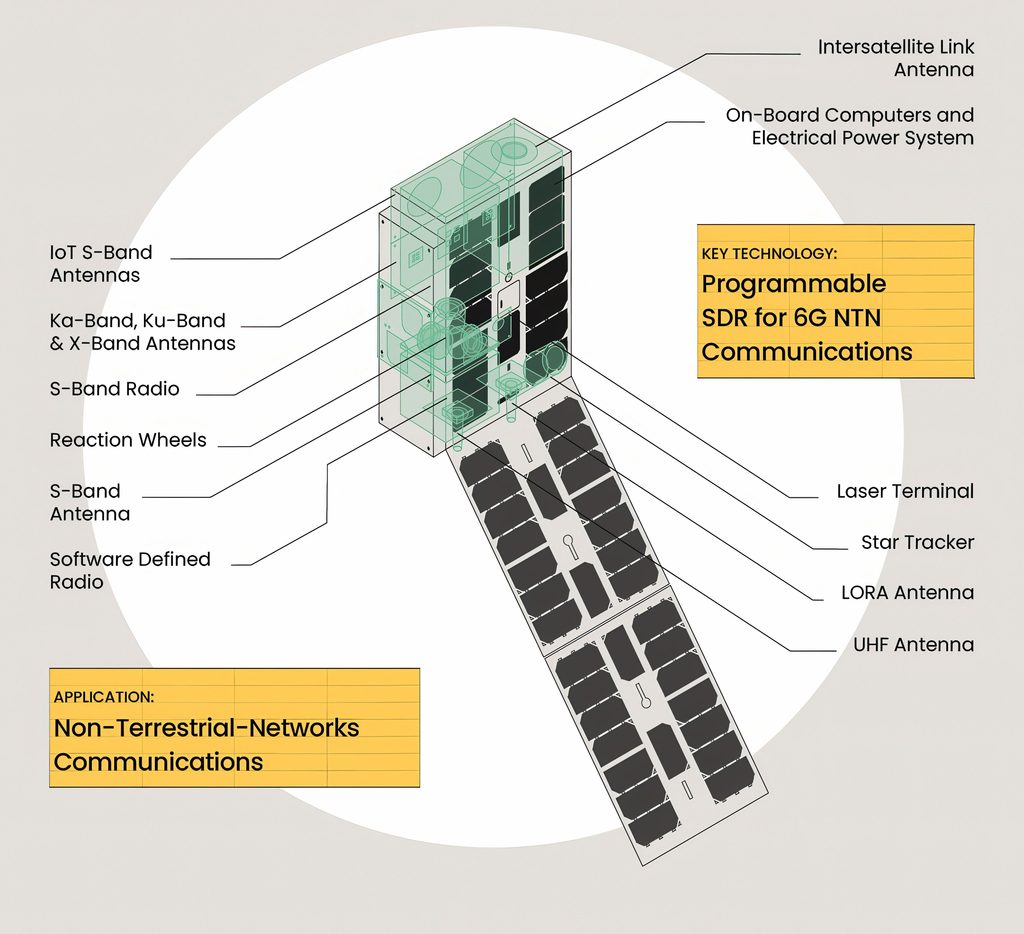
The core engine of 6GStarLab consists of dual flexible software-defined radio (SDR) payloads developed by i2CAT and MWSE. Unlike communication satellites with fixed hardware, these SDRs support transmission and reception across a wide spectrum of bands, including UHF, LoRa, L-band, S-band, X-band, Ku-band and Ka-band.
Researchers can program the SDRs to test new 6G waveforms, evaluate dynamic link optimisation algorithms and benchmark terrestrial–satellite convergence protocols in real orbital conditions (handling high Doppler shifts and signal latency variations).
To test the extreme throughput requirements expected in 6G architectures, 6GStarLab carries a high-bandwidth laser communications terminal operating in the ~1500 nm infrared wavelength range. This was developed in partnership with Transcelestial, and with dedicated ground optical receiver terminals, it provides high-throughput, low-latency, free-space optical data links between orbiting platforms and ground stations.
A custom antenna array developed by UPC’s NanoSatLab is integrated into the 6GStarLab structure to maximise the link efficiency and beam shaping across multiple RF frequencies simultaneously within the tight mechanical envelope of a 6U CubeSat.
This is intended to support experimental validation of spaceborne multifrequency communications and phased-array technology essential for direct-to-device satellite communications.
The open platform allows university teams, telecommunication operators and technology startups to submit software configurations through a dedicated web interface. Approved software routines, ranging from AI-driven channel estimation to novel 6G waveforms, are uploaded via Open Cosmos’ mission control software. The onboard SDRs then execute the experiments in orbit, measuring real-world parameters such as signal attenuation, bit-error rates, phase noise and orbital atmospheric distortion.
Diagnostic and performance data is downlinked and parsed, feeding data directly back into global scientific communities working on 6G standardisation such as 3GPP Release 19 and 20.
Technical Capabilities Summary
| Mission | Primary Technology Focus | Key Onboard Payload / Mechanism |
| Hyperion GR-1 | Optical EO | Very-high-resolution optical imager for national monitoring with AI processing on board |
| Posidònia | Coastal & marine remote sensing | VNIR multispectral and hyperspectral, SWIR multispectral with IOT and AI processing on board and real-time intersatellite links. Optical sensors providing near-real-time Mediterranean data |
| 6GStarLab | Advanced telecoms testing | Orbital testbed for 6G communications protocols |
| Phisat-2 | Edge AI & remote sensing | Onboard AI processor for real-time image filtering |
| HAMMER | Environmental intelligence | Integrated multispectral imager and near-real-time processor |
| MANTIS | Industrial EO & AI | High-resolution optical imager paired with AI processing modules |
| PLATERO | Environmental & IoT sensing | Integrated EO imager, IoT receiver, and AI analytics engine |
| ALISIO-1 | SWIR imaging & optical comms | SWIR imager + laser communication payload |
| Menut | Climate change monitoring | EO imager tuned for climate metrics |
| Dover | Navigation infrastructure | GNSS / PNT signal transmission and pathfinding payload |
| LS2 / Enxaneta | IoT & telemetry relay | Low-power narrowband IoT receiver arrays |
| qbee50-LTU-OC | Thermospheric measurement | In situ atmospheric sensors for lower thermosphere research |
UPCOMING EVENTS